Date: February 24, 2026
Status: Phase 1 (Core Vision & Logic) Complete
1. The Vision
The goal is to monitor the growth and health of coffee trees planted directly into a “large pot” floor setup. Unlike traditional grow-ops, this system uses a top-down computer vision approach to track the canopy spread and leaf health of multiple trees simultaneously from a fixed ceiling mount.
2. The Hardware Stack
- Brain: Raspberry Pi 4 (or 5)
- Storage: High-speed USB Thumb Drive (Boot Drive) to handle constant data logging without SD card failure.
- Vision: USB Webcam mounted to the ceiling for a 2D “map” view of the plantation.
- Environment: Basement-to-Grow-Tent conversion.
3. The Software (OpenCV + Python)
In just 24 hours, we developed a “One-Shot” script that performs the following every time it runs:
- Auto-Calibration: Uses a 100-frame warmup to adjust for the high-intensity grow lights.
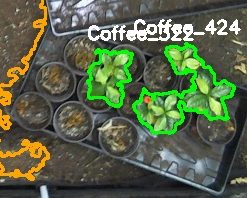
- Multi-Spectrum Masking: Separates the plants from the soil using HSV (Hue, Saturation, Value) filtering for Green (Healthy), Yellow (Warning), and Brown (Critical).
- Shape Intelligence: Implemented Aspect Ratio and Solidity filters. This allows the AI to ignore background “noise” like support poles, boxes, or equipment, focusing only on the plant canopies.
- Automated Logging: Saves an annotated visual “snapshot” and appends growth data (Area in $cm^2$) to a CSV file for long-term trend analysis.
4. Key Breakthrough: Top-Down Perspective
By shifting from a side-view to a top-down view, we eliminated the “depth problem.” On a flat floor pot, every pixel represents a constant physical size, allowing us to calculate the Total Canopy Coverage with high mathematical precision.
What’s Next?
- Automation: Setting up a
cronjob to trigger the monitor every 24 hours. - Calibration: Finalizing the Pixels-per-CM constant once the camera is in its permanent home.
- Real-World Stress Test: Moving from whiteboard drawings to actual coffee seedlings.